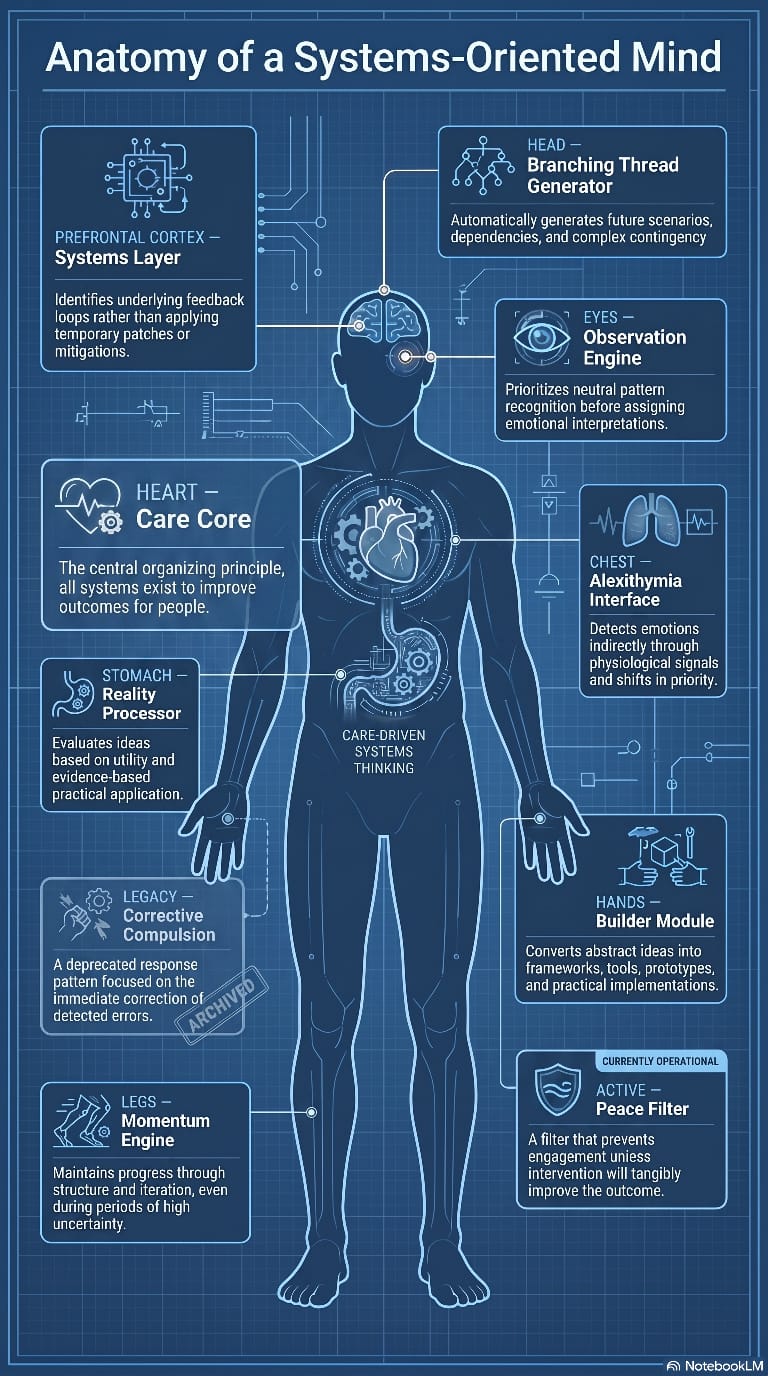
Anatomy of a Systems-Oriented Mind
or, in simpler terms: how I approach puzzles, problems, and life in general
The Context
For years, I've tried to explain how I approach problems: why I ask certain questions, how I build systems, what I notice that others might miss, and the explanations never quite worked in words alone.
This diagram maps the actual architecture. It's the result of years of introspective work, data gathering, and analysis across my personal systems and professional practice. Each component represents a real operational function.
At the center is the Care Core, the organizing principle that drives everything. Every system I build, every question I ask, every tool I create exists to improve outcomes for the people inside it.
The diagram was generated using NotebookLM with a detailed context file and prompt. The accompanying video uses the same source material, narrated by NotebookLM's default voice synthesis. Both are transparent outputs from the tool, not hand-crafted illustrations. The point is the architecture itself, not the aesthetic.
The Video
What This Means in Practice
The Prefrontal Cortex layer identifies feedback loops instead of applying quick fixes. The Observation Engine prioritizes neutral pattern recognition before emotional interpretation. The Alexithymia Interface means I detect what I'm feeling through physiological shifts and changes in priority.
The Builder Module converts abstract ideas into frameworks, tools, and templates. The Momentum Engine maintains progress through structure and iteration, even during uncertainty. The Peace Filter prevents engagement unless the intervention will tangibly improve the outcome.
This is why I design the way I do.